The Sport Pilot Chronicles

04 May 2010

The End of This Blog

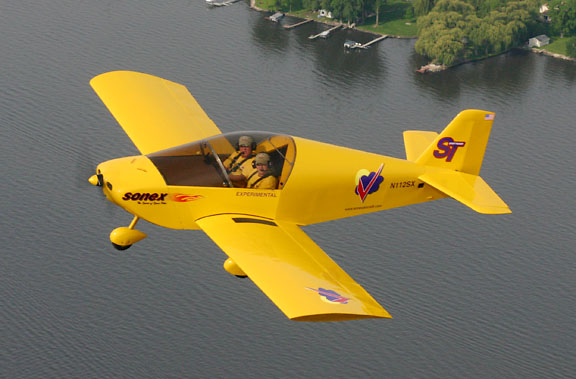
Well...I have not been posting much lately.  As my previous post indicated, I have taken a break from flying to try to scrape together money to buy an airplane.  That has changed a bit in the last few months.  I'm now going to build an airplane from a kit.  I'll be building a Sonex from the kit provided by Sonex Aircraft.  It's a small low wing, two place airplane:


The Sonex is a very efficient airframe, cruising at 130mph on only 80hp.  The engine is a modified VW engine with dual ignition and lots of other tricks.  The plane is fully aerobatic, and is rated for +6g/-3g at a weight of 950lb (basically with a single person on board).  I don't plan to do aerobatics, but having an airframe that strong can keep you out of a lot of trouble.  The empty weight is around 650lb, and maximum gross is 1100-1200lb (since it's an amateur-built airplane, you can set the gross where you want).

I'm starting a new blog to detail the construction process.  Please check out: Sonex #1416 Builder Blog if you are interested in following my progress!

20 August 2009

Taking a Break With a Purpose

I've decided to take a break from flying, with a very specific purpose in mind. I was getting checked out in the SportCruiser at Atlanta Sport Flight, but decided to not continue that. I probably won't be flying at all (other than taking rides with other pilots as they come up) for about six months.

The reason is what I'm calling the "renter's dilemma." Flying is expensive. Enough so, in fact, that just spending rental fees at $90+ per hour puts a dent in most people's (mine included) finances. What the dilemma means, in practical terms, is that as long as you keep paying for frequent airplane rentals, you can never really save the kind of money you want to become an airplane owner. Sure, you could finance an airplane, as most people do. But my wife and I don't do debt. And we certainly don't go into debt on a potentially depreciating "toy" like an airplane!

So I'm going to save some money, and hopefully more quickly get to a point where I can buy an airplane. Of course, paying all cash for an airplane more limits what types of planes one can get. I looked at a lot of options, and I think I've decided to work on buying a Luscombe 8A Silvaire. It's a modest high wing airplane with the same Continental A65 engine powering a Piper Cub, with the Luscombe cruises about 105mph instead of the Cub's 75mph. Like the Cub it has no electrical system and requires hand-propping to start.

Luscombe Model 8A "Silvaire"

The Luscombe is a bit different from other airplanes I've flown, besides the lack of electricals. It's also a "tail dragger" meaning that it has a tailwheel instead of the currently more common nosewheel. When the Luscombe 8A was built (1937 to 1949) the tailwheel arrangement was the norm, and is often called "conventional gear" by pilots.

The main difference with a tailwheel aircraft is the ground handling. Because the center of gravity (CG) is so far ahead of the tailwheel, the plane naturally wants to swap ends. That means that on the ground the pilot has to really stay on top of things, paying close attention to winds, taxi speed, and the track of the airplane. If the tail comes out too far the airplane may "ground loop," spinning itself around. This is bad. You can't really stop "flying" a taildragger until it's stopped and parked. I'll have to get trained and get a tailwheel endorsement, but that should be fun as well, and I can wait and do that when I buy the plane and actually train on my own plane.

The advantage of the tailwheel is that it's a lot smaller than a nosewheel, and doesn't hang down as far. That means much less drag, which is very important in an airplane with only 65 horsepower. Every airplane is eventually speed-limited by drag, and anything that can be done to reduce drag aids performance.

So wait, I'm looking at buying an airplane that is 60+ years old? Am I nuts?!? Won't it fall apart and kill me? Nah. First, the FAA regulates airplane maintenance in such a way that an airplane that is not airworthy should not be flying at all. Every system and critical component must be inspected annually (or every 100 hours of flight time if the plane is used for commercial operations). Also, the Luscombe has been around long enough that folks know the trouble spots. A good pre-buy inspection by a mechanic familiar with the type will reveal any corrosion problems or other trouble spots. A properly maintained Luscombe is no less safe than a newer airplane, and in many ways may be more safe, just due to the simplicity of the airplane.

13 July 2009

Flying the SportCruiser

Czech Aircraft Works SportCruiser

I finally found a rental light sport airplane in the area! It's a Czech Aircraft Works SportCruiser. operated by Atlanta Sport Flight at Fulton County airport in Atlanta (FTY). The picture above is of the exact plane (N187SF) I flew, A sexy little new low-wing plane with just 100hrs on the engine and airframe.

This airplane is made in the Czech Republic by an aircraft company that used to make airplane parts for the old Soviet Union. Once the bear dismantled, in fine capitalist style the company retooled as Czech Aircraft works (CZAW) and began producing light aircraft for the civilian market. They first built Zodiacs for Zenith Aircraft, then started making the SportCruiser as their own design.

The SportCruiser has a lot going for it. It has the same 100hp Rotax engine as the Tecnam I trained in. It's an all-metal structure, which is great for maintenance (the newer carbon fiber and fiberglass constructed planes are very strong, but much harder to repair correctly). It also has a full "glass" cockpit, meaning electronic displays rather than traditional gauges.

One thing that's very different is that the SportCruiser does not have nosewheel steering on the ground. The nosewheel is free castering, and will rotate around on its own. All steering is done by differential braking -- braking one of the main wheels causes the plane to turn in that direction. This makes the plane very maneuverable on the ground, as it can basically pivot within its own wingspan. It is not nearly as intuitive as nosewheel steering though, and I ended up taxiing like a drunken sailor. I may come to love it, but for now I found it just difficult.

The castering nosewheel also means there is little directional control on takeoff roll before the rudder becomes effective. You can tap a brake to maintain direction, but then you are slowing down just when you want to be speeding up for takeoff. I'm sure I'll get the hang of it, and a lot of other aircraft like the Grumman AA-1/AA-5 series use the same arrangement with no major problems.

How does it fly? I could describe it in one word: light. The control forces needed to control this plane are minimal; in fact they don't really seem change much. I don't think I *ever* touched the trim, and the stick forces never got heavy at any speed from 32 knots to 108 knots. This is a little puzzling to me, as I don't think the Czechs have learned a way to repeal the basic laws of aerodynamics. Nonetheless, on this flight trim was unnecessary.

Handling didn't seem unusual (other than the trim enigma), and there were no really bad habits. Stalls were benign and predictable, and turns were easy to maintain and roll into and out of. Overall it felt more like the Zodiac than the Tecnam, but not in a bad way.

The plane has big wings and lots of lift, which is evident in the 32 knot (!) rotation speed on takeoff. It's also evident in the pattern, which when properly flown is completely power off from abeam the numbers on downwind to touchdown. You essentially just glide it in, progressively adding flaps, only adding a little power if you get below the glideslope.

The big bubble canopy is a blessing and curse. You can see all around, and the only blind spot is directly to the rear. This makes spotting traffic easier, and sightseeing more enjoyable. What I know from flying the Zodiac, however, is that when the sun comes out and it's hot outside, that big greenhouse will COOK you. The SportCruiser has a retractable sunshade overhead that will help, but I think it's still going to be a sauna in there pretty often.

Then there is the low wing vs. high wing debate. I now have about equal time in low wing (Zodiac) and high wing (Tecnam) aircraft. While I think low wing planes just look better and remind me of fighter planes, for actual flying I prefer the high wing. The visibility to the ground is better, which helps in the pattern and for sightseeing. Only on the downwind-to-base turn does the high wing block your view, and it's a simple matter to lift the wing a little to peek, or just judge your turn by the compass or directional gyro. I don't mind the low wings, I just think for the things I usually want to look at the high wing is more suitable. Plus in Georgia that big wing overhead gives you some shade!

The Dynon Electron Flight Information System (EFIS). There's a LOT of data here.

And of course, don't forget the glass panel vs. steam gauge question. The glass panel gives you a LOT of information in a small area, which is nice, but sometimes it's a little tough to find the exact bit of info you want. In the picture above you can see the EFIS. In a seven inch area you have airspeed, altitude, pitch and roll attitudes, slip/skid indicator, Vertical speed, heading indication with GPS steering cue, angle of attack, wind speed and direction, ILS and VOR deviation, density altitude, outside air temperature, altimeter setting, local time, and more. And that doesn't include the other display, the Engine Monitoring System (EMS)!

All this information is great and helpful, but the density of information can be distracting. If I just want to know my airspeed, for example, it's easier to glance at a standard airspeed gauge and get that information than it is to get it off the EFIS without getting distracted by other data. I find myself looking more at the panel when I've got glass, and really that's a bad thing. You want your attention outside the airplane, looking for other traffic, and only looking at the panel occasionally to confirm what you already think is happening, such as heading and airspeed.

Honestly, I think I prefer standard gauges to glass. It's not a strong preference, but I just think it feels more like flying and less like flying a simulator. There is something to be said for keeping each piece of information separate.

So what's my overall impression of the SportCruiser? I think I'll like it in the end, but right now it's a lot of work and feels difficult. To be fair, I've felt this way every time I've transitioned to a new plane. Once I get the feel for it and the controls and procedures become second nature, I'm sure I'll really enjoy it. In the meantime I'll just keep working at it!
14 June 2009

I'm a pilot!

It's done, I passed my FAA checkride and now I'm a certificated Sport Pilot! I have not updated this blog in a while, so I guess I'll need to catch you all up.

As I mentioned in my last post, I went to Lockwood Aviation in Sebring, Florida to to to get things finished up. I scheduled eight full days of training, from Friday through the following Saturday. I ended up needing an additional two days, finishing with my checkride on Monday morning.

The folks at Lockwood are amazing, and really went out of their way to make sure I had every opportunity to fly and learn all the information I needed to be a safe and proficient pilot. All of their instructors and very skilled and also quite good at transferring those skills to their students. Their aircraft were also expertly maintained by their on-site maintenance shop. Overall the Lockwood experience was great, and I'd go back for further training without hesitation.

The FAA checkride was a nervewracking experience. None of the knowledge you have to know, or the skills you have to demonstrate are particularly difficult, but you only get one chance at each maneuver, and the tolerances for success are pretty tight. I was a wreck for about two days beforehand, but of course it wasn't as difficult as I'd made it in my mind (there's no way it could have been!).

Once it was all over I took a great long nap, then had my first flight as a licensed pilot. My wife Kellie agreed to be my first passenger, against all reason. She ended up having a really good time. I thought that the landing might be uncomfortable for her, but actually she loved landing, but hated takeoff. She didn't like how we went into an immediate crab due to the wind. Fair enough, but she's willing to go up again so I guess the freak out factor was not too high.

Now to find a plane around here that I can fly...

04 May 2009

Crazy Bad Luck and Moving On...

My bad luck with flight training continues. First it was my training plane getting wrecked on landing the day I was supposed to solo. That was pretty bad. The Zodiac came back from the repair shop on May 2.

Now this. The NTSB has issued a letter strongly urging the FAA to "prohibit further flights" of the Zodiac CH-601XL aircraft, due to six structural failure accidents causing a total of ten fatalities. Any guesses what *exact* type of aircraft I have been flying? Yep, Ch-601XL.

The FAA has not acted on this recommendation (they often ignore NTSB recommendations), but it has been an industry-wide confidence shaker. My school, for example, has decided to forego the liability issues, and voluntarily grounded the newly-repaired N130AW. So now I'm without a plane to train in again, and there are not really any other flight schools with suitable aircraft in the area that I want to train in. So where does that leave me?

Spending money, of course! I'm taking a week off of work and heading down to Lockwood Aviation in Sebring, Florida. There I'll fly several hours every day for a full week. That should be enough time to familiarize myself with the Tecnam P-92 Echo Super aircraft I'll be flying, get my solo flying time in, and take my checkride (the Lockwood senior flight instructor is an FAA examiner and will adminser my checkride oral and flight test). Here's the P-92:


Clearly a little different plane from the Zodiac. It's a high wing design, like the classic Cessnas. It also uses a Rotax engine, which is lighter weight that the Zodiac's TCM 0-200 engine and runs at a much higher RPM (5200 vs 2500) but produces the same 100 horsepower. Otherwise, performance between the planes is similar. I like how the Zodiac flies, but I'm looking forward to trying a new plane.

I'm planning to make daily updates to this blog when I'm in Florida, so look for them the week of May 30 to June 6!

08 April 2009

I Passed My Knowledge Test!

Waiting for N130AW to be repaired has been frustrating, and I have received word that it will not be back in service until the week of May 2. That means basically I will have not been in the air for nine weeks when I get to fly again.

I decided I didn't want all of that time to be wasted, so I started studying for the FAA knowledge test needed to get my pilot certificate. The test is a comprehensive test covering all aspects of flying including weather, procedures, regulations, aircraft systems, flight dynamics, and navigation among others. The test is a 40 question multiple choice test. That sounds easy, but the 40 questions are randomly selected from a bank of hundreds of questions. The only way to do well on the test is to all the material cold, since there's no way to know which questions you might be asked, or on what topics. The test is administered on a computer and 120 minutes are allowed to complete the test.

I brought the allowed items into the test: a flight calculator, a navigation plotter, and a pencil for working out any problems (scratch paper is provided and must be surrendered on leaving). You are given a booklet that has all the charts, tables, illustrations, and figures referenced in the test questions. You are only allowed to write on your scratch paper, not on the booklet.

I found the test to be pretty easy, but I think I lucked out in the random questions I was asked. They were mostly "simple" questions, not requiring any calculations. In fact, I only needed my flight calculator for one question. There were none of the "math intensive" questions I had studied, mostly navigation and weight/balance questions. Lucky in one sense, but a little disappointing I didn't get to put the skill I'd learned to use.

A score of 70% is passing. I scored 98%, meaning I missed one question. There were three questions on the test I had never seen before in my studying, and I'm pretty sure which one I missed. I really wanted to get 100%, but it's rare for anyone to get a perfect score, so I don't feel too badly. In fact, I'm very happy...I got a very good score and it's now behind me!

10 March 2009

Just My Luck

I'm all ready to solo, butterflies in my stomach, excited and nervous. Then the flight school calls two hours before my flight. It turns out that Zodiac 130AW, the plane I was training in, had an accident on landing at the hands of a renter.

The plane was landed hard in a crosswind without proper crosswind correction. This caused the nose gear to fold about ninety degrees, which in turn caused the nose to lower enough for the propeller to strike the runway. This is a Bad Thing, because it destroyed the prop, and the prop is directly connected to the crankshaft of the Teledyne Continental Motors (TCM) 0-200 engine. That means the engine must be removed from the plane, torn down completely, and inspected for damage. It could be fine, or it could be time for a costly major overhaul of all the internals.

What does this mean for me? Sigh...it means I will not be flying the Zodiac for several weeks, at least. There are no other nearby flight schools offering Sport Pilot training. Peachtree-Dekalb airport (PDK) has it, but it's farther away (about an hour's drive or more) and it's is one of the most busy class delta airports in the nation. I don't think I want that kind of pressure during training.

I could take a couple of weeks and go to an accelerated sport pilot training course and finish up quickly, but that's at the whim of the weather, and I've already taken something like 50 hours off work for flight training already, so I'm not thrilled about burning up the rest of my leave.

For now I think I'll just wait and see what happens with N130AW. If it will only be down a few weeks, I can tough it out. If it will be 6, 8, 10+ weeks, I'll have to reevaluate what to do to get this thing finished. In the meantime I'm studying so I can get my written test out of the way.

Sigh...

Followers