20 August 2009

Taking a Break With a Purpose

I've decided to take a break from flying, with a very specific purpose in mind. I was getting checked out in the SportCruiser at Atlanta Sport Flight, but decided to not continue that. I probably won't be flying at all (other than taking rides with other pilots as they come up) for about six months.

The reason is what I'm calling the "renter's dilemma." Flying is expensive. Enough so, in fact, that just spending rental fees at $90+ per hour puts a dent in most people's (mine included) finances. What the dilemma means, in practical terms, is that as long as you keep paying for frequent airplane rentals, you can never really save the kind of money you want to become an airplane owner. Sure, you could finance an airplane, as most people do. But my wife and I don't do debt. And we certainly don't go into debt on a potentially depreciating "toy" like an airplane!

So I'm going to save some money, and hopefully more quickly get to a point where I can buy an airplane. Of course, paying all cash for an airplane more limits what types of planes one can get. I looked at a lot of options, and I think I've decided to work on buying a Luscombe 8A Silvaire. It's a modest high wing airplane with the same Continental A65 engine powering a Piper Cub, with the Luscombe cruises about 105mph instead of the Cub's 75mph. Like the Cub it has no electrical system and requires hand-propping to start.

Luscombe Model 8A "Silvaire"

The Luscombe is a bit different from other airplanes I've flown, besides the lack of electricals. It's also a "tail dragger" meaning that it has a tailwheel instead of the currently more common nosewheel. When the Luscombe 8A was built (1937 to 1949) the tailwheel arrangement was the norm, and is often called "conventional gear" by pilots.

The main difference with a tailwheel aircraft is the ground handling. Because the center of gravity (CG) is so far ahead of the tailwheel, the plane naturally wants to swap ends. That means that on the ground the pilot has to really stay on top of things, paying close attention to winds, taxi speed, and the track of the airplane. If the tail comes out too far the airplane may "ground loop," spinning itself around. This is bad. You can't really stop "flying" a taildragger until it's stopped and parked. I'll have to get trained and get a tailwheel endorsement, but that should be fun as well, and I can wait and do that when I buy the plane and actually train on my own plane.

The advantage of the tailwheel is that it's a lot smaller than a nosewheel, and doesn't hang down as far. That means much less drag, which is very important in an airplane with only 65 horsepower. Every airplane is eventually speed-limited by drag, and anything that can be done to reduce drag aids performance.

So wait, I'm looking at buying an airplane that is 60+ years old? Am I nuts?!? Won't it fall apart and kill me? Nah. First, the FAA regulates airplane maintenance in such a way that an airplane that is not airworthy should not be flying at all. Every system and critical component must be inspected annually (or every 100 hours of flight time if the plane is used for commercial operations). Also, the Luscombe has been around long enough that folks know the trouble spots. A good pre-buy inspection by a mechanic familiar with the type will reveal any corrosion problems or other trouble spots. A properly maintained Luscombe is no less safe than a newer airplane, and in many ways may be more safe, just due to the simplicity of the airplane.

13 July 2009

Flying the SportCruiser

Czech Aircraft Works SportCruiser

I finally found a rental light sport airplane in the area! It's a Czech Aircraft Works SportCruiser. operated by Atlanta Sport Flight at Fulton County airport in Atlanta (FTY). The picture above is of the exact plane (N187SF) I flew, A sexy little new low-wing plane with just 100hrs on the engine and airframe.

This airplane is made in the Czech Republic by an aircraft company that used to make airplane parts for the old Soviet Union. Once the bear dismantled, in fine capitalist style the company retooled as Czech Aircraft works (CZAW) and began producing light aircraft for the civilian market. They first built Zodiacs for Zenith Aircraft, then started making the SportCruiser as their own design.

The SportCruiser has a lot going for it. It has the same 100hp Rotax engine as the Tecnam I trained in. It's an all-metal structure, which is great for maintenance (the newer carbon fiber and fiberglass constructed planes are very strong, but much harder to repair correctly). It also has a full "glass" cockpit, meaning electronic displays rather than traditional gauges.

One thing that's very different is that the SportCruiser does not have nosewheel steering on the ground. The nosewheel is free castering, and will rotate around on its own. All steering is done by differential braking -- braking one of the main wheels causes the plane to turn in that direction. This makes the plane very maneuverable on the ground, as it can basically pivot within its own wingspan. It is not nearly as intuitive as nosewheel steering though, and I ended up taxiing like a drunken sailor. I may come to love it, but for now I found it just difficult.

The castering nosewheel also means there is little directional control on takeoff roll before the rudder becomes effective. You can tap a brake to maintain direction, but then you are slowing down just when you want to be speeding up for takeoff. I'm sure I'll get the hang of it, and a lot of other aircraft like the Grumman AA-1/AA-5 series use the same arrangement with no major problems.

How does it fly? I could describe it in one word: light. The control forces needed to control this plane are minimal; in fact they don't really seem change much. I don't think I *ever* touched the trim, and the stick forces never got heavy at any speed from 32 knots to 108 knots. This is a little puzzling to me, as I don't think the Czechs have learned a way to repeal the basic laws of aerodynamics. Nonetheless, on this flight trim was unnecessary.

Handling didn't seem unusual (other than the trim enigma), and there were no really bad habits. Stalls were benign and predictable, and turns were easy to maintain and roll into and out of. Overall it felt more like the Zodiac than the Tecnam, but not in a bad way.

The plane has big wings and lots of lift, which is evident in the 32 knot (!) rotation speed on takeoff. It's also evident in the pattern, which when properly flown is completely power off from abeam the numbers on downwind to touchdown. You essentially just glide it in, progressively adding flaps, only adding a little power if you get below the glideslope.

The big bubble canopy is a blessing and curse. You can see all around, and the only blind spot is directly to the rear. This makes spotting traffic easier, and sightseeing more enjoyable. What I know from flying the Zodiac, however, is that when the sun comes out and it's hot outside, that big greenhouse will COOK you. The SportCruiser has a retractable sunshade overhead that will help, but I think it's still going to be a sauna in there pretty often.

Then there is the low wing vs. high wing debate. I now have about equal time in low wing (Zodiac) and high wing (Tecnam) aircraft. While I think low wing planes just look better and remind me of fighter planes, for actual flying I prefer the high wing. The visibility to the ground is better, which helps in the pattern and for sightseeing. Only on the downwind-to-base turn does the high wing block your view, and it's a simple matter to lift the wing a little to peek, or just judge your turn by the compass or directional gyro. I don't mind the low wings, I just think for the things I usually want to look at the high wing is more suitable. Plus in Georgia that big wing overhead gives you some shade!

The Dynon Electron Flight Information System (EFIS). There's a LOT of data here.

And of course, don't forget the glass panel vs. steam gauge question. The glass panel gives you a LOT of information in a small area, which is nice, but sometimes it's a little tough to find the exact bit of info you want. In the picture above you can see the EFIS. In a seven inch area you have airspeed, altitude, pitch and roll attitudes, slip/skid indicator, Vertical speed, heading indication with GPS steering cue, angle of attack, wind speed and direction, ILS and VOR deviation, density altitude, outside air temperature, altimeter setting, local time, and more. And that doesn't include the other display, the Engine Monitoring System (EMS)!

All this information is great and helpful, but the density of information can be distracting. If I just want to know my airspeed, for example, it's easier to glance at a standard airspeed gauge and get that information than it is to get it off the EFIS without getting distracted by other data. I find myself looking more at the panel when I've got glass, and really that's a bad thing. You want your attention outside the airplane, looking for other traffic, and only looking at the panel occasionally to confirm what you already think is happening, such as heading and airspeed.

Honestly, I think I prefer standard gauges to glass. It's not a strong preference, but I just think it feels more like flying and less like flying a simulator. There is something to be said for keeping each piece of information separate.

So what's my overall impression of the SportCruiser? I think I'll like it in the end, but right now it's a lot of work and feels difficult. To be fair, I've felt this way every time I've transitioned to a new plane. Once I get the feel for it and the controls and procedures become second nature, I'm sure I'll really enjoy it. In the meantime I'll just keep working at it!

14 June 2009

I'm a pilot!

It's done, I passed my FAA checkride and now I'm a certificated Sport Pilot! I have not updated this blog in a while, so I guess I'll need to catch you all up.

As I mentioned in my last post, I went to Lockwood Aviation in Sebring, Florida to to to get things finished up. I scheduled eight full days of training, from Friday through the following Saturday. I ended up needing an additional two days, finishing with my checkride on Monday morning.

The folks at Lockwood are amazing, and really went out of their way to make sure I had every opportunity to fly and learn all the information I needed to be a safe and proficient pilot. All of their instructors and very skilled and also quite good at transferring those skills to their students. Their aircraft were also expertly maintained by their on-site maintenance shop. Overall the Lockwood experience was great, and I'd go back for further training without hesitation.

The FAA checkride was a nervewracking experience. None of the knowledge you have to know, or the skills you have to demonstrate are particularly difficult, but you only get one chance at each maneuver, and the tolerances for success are pretty tight. I was a wreck for about two days beforehand, but of course it wasn't as difficult as I'd made it in my mind (there's no way it could have been!).

Once it was all over I took a great long nap, then had my first flight as a licensed pilot. My wife Kellie agreed to be my first passenger, against all reason. She ended up having a really good time. I thought that the landing might be uncomfortable for her, but actually she loved landing, but hated takeoff. She didn't like how we went into an immediate crab due to the wind. Fair enough, but she's willing to go up again so I guess the freak out factor was not too high.

Now to find a plane around here that I can fly...

04 May 2009

Crazy Bad Luck and Moving On...

My bad luck with flight training continues. First it was my training plane getting wrecked on landing the day I was supposed to solo. That was pretty bad. The Zodiac came back from the repair shop on May 2.

Now this. The NTSB has issued a letter strongly urging the FAA to "prohibit further flights" of the Zodiac CH-601XL aircraft, due to six structural failure accidents causing a total of ten fatalities. Any guesses what *exact* type of aircraft I have been flying? Yep, Ch-601XL.

The FAA has not acted on this recommendation (they often ignore NTSB recommendations), but it has been an industry-wide confidence shaker. My school, for example, has decided to forego the liability issues, and voluntarily grounded the newly-repaired N130AW. So now I'm without a plane to train in again, and there are not really any other flight schools with suitable aircraft in the area that I want to train in. So where does that leave me?

Spending money, of course! I'm taking a week off of work and heading down to Lockwood Aviation in Sebring, Florida. There I'll fly several hours every day for a full week. That should be enough time to familiarize myself with the Tecnam P-92 Echo Super aircraft I'll be flying, get my solo flying time in, and take my checkride (the Lockwood senior flight instructor is an FAA examiner and will adminser my checkride oral and flight test). Here's the P-92:


Clearly a little different plane from the Zodiac. It's a high wing design, like the classic Cessnas. It also uses a Rotax engine, which is lighter weight that the Zodiac's TCM 0-200 engine and runs at a much higher RPM (5200 vs 2500) but produces the same 100 horsepower. Otherwise, performance between the planes is similar. I like how the Zodiac flies, but I'm looking forward to trying a new plane.

I'm planning to make daily updates to this blog when I'm in Florida, so look for them the week of May 30 to June 6!

08 April 2009

I Passed My Knowledge Test!

Waiting for N130AW to be repaired has been frustrating, and I have received word that it will not be back in service until the week of May 2. That means basically I will have not been in the air for nine weeks when I get to fly again.

I decided I didn't want all of that time to be wasted, so I started studying for the FAA knowledge test needed to get my pilot certificate. The test is a comprehensive test covering all aspects of flying including weather, procedures, regulations, aircraft systems, flight dynamics, and navigation among others. The test is a 40 question multiple choice test. That sounds easy, but the 40 questions are randomly selected from a bank of hundreds of questions. The only way to do well on the test is to all the material cold, since there's no way to know which questions you might be asked, or on what topics. The test is administered on a computer and 120 minutes are allowed to complete the test.

I brought the allowed items into the test: a flight calculator, a navigation plotter, and a pencil for working out any problems (scratch paper is provided and must be surrendered on leaving). You are given a booklet that has all the charts, tables, illustrations, and figures referenced in the test questions. You are only allowed to write on your scratch paper, not on the booklet.

I found the test to be pretty easy, but I think I lucked out in the random questions I was asked. They were mostly "simple" questions, not requiring any calculations. In fact, I only needed my flight calculator for one question. There were none of the "math intensive" questions I had studied, mostly navigation and weight/balance questions. Lucky in one sense, but a little disappointing I didn't get to put the skill I'd learned to use.

A score of 70% is passing. I scored 98%, meaning I missed one question. There were three questions on the test I had never seen before in my studying, and I'm pretty sure which one I missed. I really wanted to get 100%, but it's rare for anyone to get a perfect score, so I don't feel too badly. In fact, I'm very happy...I got a very good score and it's now behind me!

10 March 2009

Just My Luck

I'm all ready to solo, butterflies in my stomach, excited and nervous. Then the flight school calls two hours before my flight. It turns out that Zodiac 130AW, the plane I was training in, had an accident on landing at the hands of a renter.

The plane was landed hard in a crosswind without proper crosswind correction. This caused the nose gear to fold about ninety degrees, which in turn caused the nose to lower enough for the propeller to strike the runway. This is a Bad Thing, because it destroyed the prop, and the prop is directly connected to the crankshaft of the Teledyne Continental Motors (TCM) 0-200 engine. That means the engine must be removed from the plane, torn down completely, and inspected for damage. It could be fine, or it could be time for a costly major overhaul of all the internals.

What does this mean for me? Sigh...it means I will not be flying the Zodiac for several weeks, at least. There are no other nearby flight schools offering Sport Pilot training. Peachtree-Dekalb airport (PDK) has it, but it's farther away (about an hour's drive or more) and it's is one of the most busy class delta airports in the nation. I don't think I want that kind of pressure during training.

I could take a couple of weeks and go to an accelerated sport pilot training course and finish up quickly, but that's at the whim of the weather, and I've already taken something like 50 hours off work for flight training already, so I'm not thrilled about burning up the rest of my leave.

For now I think I'll just wait and see what happens with N130AW. If it will only be down a few weeks, I can tough it out. If it will be 6, 8, 10+ weeks, I'll have to reevaluate what to do to get this thing finished. In the meantime I'm studying so I can get my written test out of the way.

Sigh...

06 March 2009

Pre-Solo Passed & Emergency Procedures

I passed my pre-solo test today with flying colors, so Eric told me to expect to solo either Sunday or Monday...gulp! I think I'm ready, but there is a natural amount or apprehension and nerves that go with getting in an airplane and flying it around with no safety net in the form of an experienced in the right seat.

This morning we practiced engine out emergencies in the Zodiac. First a simulated off field landing from 3500 feet. This is not hard, you just pick a landing spot you can glide to and pitch the airplane for best glide speed (65 knots in the Zodiac). One thing Eric mentioned and I definitely found is that a field that looks great at 3500 feet might look questionable down low. The field I picked looked great up high, but once we got lower it looked a little small and had tall trees on the side I was approaching from. Clearly another case of something in aviation you need to be very conservative about.

We then went to WDR and did some simulated engine outs in the pattern and power off landings. This is an area where a Zodiac is not like a Cessna; once you pull the power to idle in the Zodiac it starts to come down like a meteor. At the 65 knot approach speed we were seeing sink rates up to 1200fpm. Our firt try at this in a normal pattern made it clear we could not make the runway from abeam the numbers. On the second try as soon as I cut the throttle abeam the runway numbers I started a moderate 180 degree turn. This time we made it very well. I gave the plane a little throttle just before the flair to soften the landing, but we would have made it easily even with no power. It just would have been a hard impact landing.

The Zodiac is a great plane, and a lot of fun. A Glider it aint.

05 March 2009

Pre-Solo Test Tomorrow

Has it really been almost a month?!? Oh well. In that month, I had seven flight lessons scheduled. Five of seven were canceled due to weather. Highly annoying. I had a lesson two weeks ago, and it was bad; my head just was not in the game. I made five landings -- one of them was really good, two were just okay, and two severely sucked. Nothing dangerous, just pretty marginal technique on my part.

Then yesterday I had another lesson. That one went very well. No major mistakes, though I did miss one ATC radio call. Eric made the reply and didn't say anything, so I guess it's not a biggie. My landings were much better, but I am still having a some problems holding off the nosewheel enough on touchdown...I'll have to play with my stick technique after the main gear touches down and see if I can figure that out.

Tomorrow I have another lesson, and it's going to be some ground school and the FAA mandated pre-solo test. Once that and some logbook endorsements are out of the way, eric will be able to spring my first solo on me whenever he chooses. That's pretty scary, but one learns by doing, right? Wish me luck!

16 February 2009

Another Scrubbed Flight and a New Headset

Argh, I was unable to fly Saturday as planned, due to weather. 700ft ceilings and rain are not conducive to student VFR flight. Ah well...I am on the schedule to fly both next Saturday and Sunday, so hopefully two flights close together will make up for the fact I will not have been able to fly in two weeks. It's frustrating to get close to solo and then have to wait so long, hoping my skills don't atrophy to uselessness and end up requiring more hours to get back up to speed.

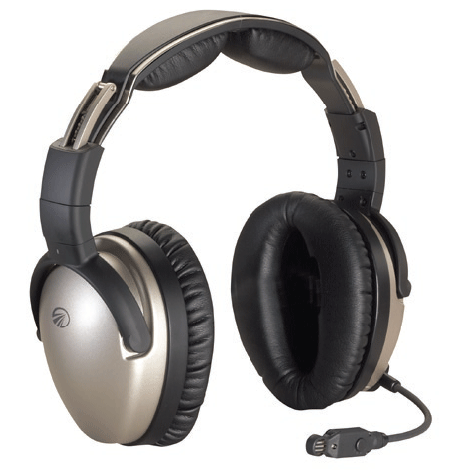
Equally frustrating is that I just got a new headset to wear in the cockpit, and I have not been able to try it out! I had to return my previous headset from Quiet Technologies; though I loved how light and comfortable it is, it turns out that that lightness also makes it susceptible to radio interference, and I was getting a horrendous squeal from the radio. So I got one of these:

My new set is a fancy Active Noise Reduction (ANR) headset, the Lightspeed Zulu. ANR uses electronics to actively cancel outside noise by using a "mirror image" soundwave to remove outside noise. The Zulu and the Bose Aviation Headset X are considered the two top ANR headsets currently -- I chose the Zulu because it is $150 less than the Bose, and has more audio features. For example, the Zulu has Bluetooth so you can connect wirelessly to a mobile phone, and also has a 1/8" audio-in jack for connecting to an MP3 player or other audio source in flight. The Bose has neither feature, and the audio for both headsets is rated comparably, so it was a no-brainer for me.

Why would you want to talk on a mobile phone in flight? Well, besides the obvious social calls, and telling folks when you are arriving at the airport, you can also use it to contact a Flight Service Station (FSS) to get weather updates while in the air. You can also do this using the radio, but it's good to have options! I think it will be a while if ever before I'd be comfortable enough to try to fly and chat on the phone, but I want a headset that will grow with me!

07 February 2009

The "S" Word


I've wrapped up my week of flight training; I have flown seven of the last eight days. I now have over 30 landings under my belt in the Zodiac, and they are no longer the mildly terrifying events they were the first few times. Now they are fun, and each one is a challenge to make the best approach and touchdown I can. I've gotten much better at them, and I can usually hold off on touchdown until I make it nice and gentle. The only issue I still have is that I occasionally still "plop" the nosewheel down after touchdown, but I'm getting better.

In the last couple of lessons we've also added radio communications with air traffic control (ATC) and other aircraft into the mix. Previously Eric had handled all the radio calls while I flew. I had spent a lot of time preparing for this, reading books and articles on proper communications requirements and etiquette. I was really nervous about talking on the radio, but after doing it for a couple of flights, I find to my surprise I actually enjoy the radio work. I'm not sure why, but it's kind of fun to talk to people when you're flying and let them know what you're up to.

So now Eric is using the "S" word: SOLO. That means making three circuits around the pattern, including three takeoffs and landings...by myself. This propect is both exciting and mildly terrifying. I'm pretty sure I can get the plane on the ground okay, but if I forget something or something goes wrong, there is nobody there to save my bacon. Once the wheels lift off, the plane will not get back on the ground safely unless I get it there.

The plan seems to be for me to solo during the next lesson where the weather permits and Eric sees me make at least three good landings with him first. Wish me luck!

03 February 2009

Lesson 6: Slips, Emergency Procedures, Crosswind Landings

This was a really packed lesson. We first did a few turns to get warmed up, then I learned how to slip. A slip is when you use a (usually strong) rudder deflection, coupled with opposite aileron. It is usually used to stay centered on the runway during a crosswind landing, or to lose altitude quickly by inducing a strong sink rate. There's nothing difficult about it, though I have not used one on landing (we usually use a different method, "crabbing" with the Zodiac, due to the Zodiac already having a pretty strong tendency to sink on approach).

We then did a simulated engine out descent to an off field landing. Not much different than a standard descent, pitch for best glide (65 knots), then look for a flat spot to set her down on. In an actual emergency you want to set the plane down as slowly as possible to avoid damaging people (primarily) or the plane (severely secondary).

The winds picked up after that, so we flew to Winder (KWDR) for some crosswind landings. It's hard enough for me to land at this point, but add a wind blowing directly across the runway and it gets really hairy. We did three of those at KWDR and then another one back at at Gwinnett (KLZU). That last one was really tough, and I almost had to abort and do a "go around" for another try, but salvaged it in the last few hundred feet.

Eric said I am really improving, so that's good enough for me!

02 February 2009

Lessons 4 & 5: I Landed an Airplane!

My last two lessons have included some review and basic flight maneuvers, but have been mainly concerned with...gulp...landings. I did not think I'd be trying to land the airplane so quickly, but so far I've managed to get it on the ground six times and have not bent or broken anything. A few of those landings could not exactly be termed "gentle," but as I said, nothing broken.

Maintaining airspeed, pitch, and sink rate (vertical speed) in the Zodiac is turning out to be a little on the difficult side. I don't think I'm pitching up enough when I add the full flaps, and that lets the speed build up quickly, which is no good. And if you get too slow the Zodiac starts to sink like a stone. It's a balancing act to keep everything just right, and I'm slowly learning how to best juggle everything. I'm getting more willing to make control movements without waiting for Eric to tell me, which is good, but I still miss a lot.

I'm also drifting off the centerline of the runway a lot, leading to some gross corrections. Eric mentioned that he wants me to make smaller corrections earlier, but honestly I think I'm having trouble keeping everything going at the same time. More practice is clearly the remedy here.

I'm scheduled for four hours of training tomorrow, so if I'm not a total basket case by the end of that, I should learn a lot and get in lots of practice, if the weather cooperates. I noticed today I'm getting more comfortable in the plane overall, and not being so ginger on the controls. The result seems to be more positive aircraft control and smoother maneuvers.

01 February 2009

Packing In the Time

Flight training is hard to do...you have work and other commitments during the week, and it's especially hard in the winter because the says are so short...there are no real flyable hours for a beginning student before or after working hours. Weekends are fine, but skills can degrade a lot during the week, and if the weekend weather does not cooperate you might not fly for two or three weeks.

My solution, implemented starting tomorrow, is to take time off work to train. I have taken the entire week off, and I am scheduled to fly twice per day! That's a lot of flying, and I'm hoping my skill level will improve markedly. I flew twice in the last two days and I can see a difference just between those two days, so that's good.

The forecast is for great weather all week, except some brief nastiness tomorrow (Monday), so keep your fingers crossed!

Lesson 3: Power Off Stalls

Okay, my lesson yesterday was on power off stalls. People without a lot of aviation knowledge hear "stall" and have visions of airplanes falling from the sky. It's really nothing like that, and is a very mild event. It occurs when the wing exceeds its critical angle of attack, the angle at which the wing loses lift and air stops flowing smoothly over it.

Stall recovery is generally pretty easy. You simply lower the angle of attack (typically by lowering the pitch of the airplane) and/or add power to increase airspeed. You also need to make sure the plane stays level and does not roll off onto one wing (which is the entry into a spin, which is generally not a good thing unless you are doing aerobatics or otherwise intentionally spinning the airplane).

In the Zodiac the spins are pretty much a non-event. As you lower the speed you have to pitch the nose up a bit to maintain altitude. With the flaps down the stall warning horn starts to make noise at about 50 knots, but the stall doesn't actually occur until about 38 knots. So there is plenty of time to know it's coming. The stall does not break sharply in the Zodiac; instead the plane just starts to mush, with the controls getting soft and movements needed to make changes get exaggerated. At the same time the vertical speed picks up, and even though you are level, you are sinking quite rapidly (500-1000 feet per minute).

Recovery is done by simply letting the nose come down (it wants to anyway) and adding power. The plane flies itself out of the stall almost instantly. The plane WANTS to fly. So that's it, power off stalls. Power on stalls will come later, and occur without reducing to power or lowering the flaps, instead using pitch to raise the angle of attack to the critical point.

27 January 2009

Sport Pilot vs. Private Pilot...What's the Difference?

I have mentioned on this blog that my flight training is designed to obtain a Sport Pilot Certificate (SPC), as opposed to a Private Pilot Certificate (PPC). So...what's the difference?

In order to become a pilot, traditionally the only way to do so (unless you want to fly an ultralight) was to obtain a PPC. The major requirements for the PPC are pretty straightforward:

1) Have a minimum of 40 hours of flight experience, including at least 20 hours of dual instruction and ten hours of solo flight, including three hours of night flying and a cross-country flight of at least 150 nautical miles.

2) Pass written, oral, and practical tests on flight skills and aeronautical knowledge in numerous fields including aircraft systems, flight theory, weather, and FAA regulations.

3) Ability to obtain an FAA Class III medical certificate (every five years for those under 40, every two for those 40+), which requires an exam and disclosure of any existing and some past medical conditions.

In 2005 the FAA codified the SPC, after a long lobbying effort by organizations like the Experimental Aircraft Association (EAA) and Aircraft Owners and Pilot Association (AOPA). The idea is to provide a way to get more pilots into the air in a less expensive and time-consuming manner, while maintaining the high standard of safety and proficiency the FAA expects of all pilots. To that end, the major differences in requirements between the SPC and PPC are:

1) Roughly half the flight experience requirements: a minimum of 20 hours of flight experience, including at least 15 hours of dual instruction and five hours of solo flight, and a cross-country flight of at least 75 nautical miles.

2) No medical certificate required. Instead, a sport pilot may "self certify" that he/she is medically fit to perform any flight, as long as he or she holds a valid state driver's license and has not failed an FAA medical (and not subsequently gotten a pass on the medical).

The idea with the medical requirement is that if you are healthy enough to legally drive a car, you can make the determination if you are healthy enough to fly. This is not a blank check; you are expected by the FAA to ground yourself if you have any medical condition that would impair your ability to safely conduct the flight in question. Failure to do so could, if you then caused an accident, result in suspension or revocation of your SPC, and other fines and sanctions as well.

And while the flight training requirements are roughly half of the PPC, in the real world that's not the case. The skills needed to fly any airplane are mostly the same, and the fact is those skills can't be rushed. My instructor told me he has yet to see a student that took any less time to solo for an SPC than for a PPC. So in reality I'd be surprised to see many students getting an SPC in less than 40-50 flight hours. The national average for PPC flight hours is about 60-70.

Okay, so what are the disadvantages of the SPC? Well, there are several limitations on where/when you can fly:

1) Flights must be conducted in clear VFR conditions (3 miles visibility, 1000ft ceilings).

2) Flights must be conducted during daylight hours (no night flights).

3) Flights must be conducted at 10,000 feet or below.

4) Cannot fly in tower-controlled airspace (class A, B, C) without additional training and a logbook endorsement.

5) Cannot fly in an aircraft with a faster level flight speed than 87 knots without additional training and a logbook endorsement.

6) Must only fly Light Sport Aircraft (LSA).

7) May carry no more than one passenger other than the pilot.

That looks like a long list, but in reality many of them are not limitations that are significantly painful. Most General Aviation (GA) pilots spend most of their time below 10,000 feet, and most spend very little time flying at night. And most can count on one hand the number of times they have filled more than two seats in their airplanes. Since logbook endorsements can remove some of the other restrictions, in reality there are few very onerous limitations. One tough one is the requirement to fly only LSAs.

What's an LSA? It's a plane that has a stall speed less than 45 knots, a top speed no more thna 120 knots (138mph), and weighs less than 1320 pounds. That is a tough requirement for a plane to make, but there are some really nice planes that do meet that definition. Look at the sexy planes pictured below:


So there you have it, the differences between a sport pilot and private pilot in a nutshell. And you got to see pictures of airplanes, too!

24 January 2009

Flight Scrubbed

My scheduled flight today was canceled due to weather. Rain, low visibility, and lowering ceilings combined to make it nowhere near a VFR day. I went to the flight school anyway hoping against hope things would clear during the 40 minute drive, but no dice.

I knew this would happen sometimes, and is just one of the aspects of flying VFR. It's mildly frustrating, but I'd rather miss a few lessons than go up in unsafe conditions.

The bad news is that my next scheduled flight is not until a week from today. But the good news is that at that point I'm taking a week off from work. During that time I'm going to be flying twice a day, to really knock out some hours.

Assuming the weather holds, of course...

21 January 2009

Lesson 2: Standard Turns and Descents

My second lesson was on Monday, the MLK holiday. It was significantly warmer than the frigid first flight last Saturday, but overcast. But the ceiling was 8000 feet, with almost no wind and no precipitation forecast, so the flight was still a "go."

Eric let me pre-flight the plane this time, under his watchful eye. I didn't rush, and just followed the pre-flight checklist. I paid close attention to all of the Zodiac-specific items Eric had shown me to look at last lesson. There was only about nine gallons of fuel in the plane, so I was able to take my time while we waited for the fuel truck to arrive. I basically went through the pre-flight twice to make sure I didn't miss anything.

We boarded, got the engine started and got a taxi clearance from the tower, then headed to runway 25 (runway numbers are based on their direction to the nearest ten degrees and dropping the final zero, so traveling down runway 25 is roughly 250 degrees, or 20 degrees off due West). Eric let me go through the runup and pre-takeoff checklist, making sure everything was working properly before geing airborne.

After takeoff we turned eastward and climbed to 5500 feet, then started practicing turns. This time Eric specified "standard rate" turns, which are 30 degrees of bank. At that bank angle a little back pressure is needed on the stick to keep from descending in the turn; I mostly held altitude well, but did sink or rise up occasionally as I worked on getting the stick forces just right. We did some 360 degree turns in both directions then went on to descents.

We set up for a simulated descent to landing. At Eric's direction I cut the throttle from 2300rpm to 1700rpm, which caused the nose to drop 5-10 degrees and the plane to enter a gentle 600 feet per second descent. I added some nose up trim to bring the descent to 500fpm, and this bled our speed down to about 65-70 knots. Eric then had me lower the flaps as if preparing for a landing.

That's when I had my first "oh shit" moment in an airplane. When the flaps are added in the Zodiac, the nose pitches down sharply. Since the Zodiac's flaps don't create a large amount of drag as they do in some planes, speed can build up quickly. Since I was not prepared for the attitude change, the nose fell quickly and we sped right up. "My controls," Eric said immediately and took over, leveling us out. We actually hit 90 knots before slowing back to 65 knots to continue the descent. The maximum designed flaps down speed of the Zodiac is 80 knots. Oops.

Eric just made sure I understood what happened, and how to make sure it didn't happen again. We tried it again, and I did much better, though I had to hunt around a little for the right amount of pressure to counter the pitch change when adding the flaps. So okay, I'll have to keep working on that one...

We did a few more turns, then headed back to base. We called in to the airport at ten miles out, and were told to make a straight in approach back to runway 25. Eric let me run the descent until we were on the extended final about three miles out, where he took over and made the landing, then had me taxi back to the school.

It was a good lesson, and I am starting to appreciate how challenging some of these pilot skills are going to be to master. I'm both looking forward to and dreading the lesson where I'll have to try my first landing! That's a way off though, and the next lesson is stalls, which should be both harrowing and fun. That will be next Saturday. I wish I could get back in the air sooner, but the airport is a half hour from me, and I work 8am-5pm, so weekday scheduling is a little tough. I'm looking into a way around that -- if it works out I'll post about it.

20 January 2009

It All Starts Somewhere

After about nine months of preparing to begin flight training, this weekend I finally got started! I had been trying to decide whether to go for my Private Pilot Certificate (PPC) or my Sport Pilot Certificate (SPC). On a vacation last week to Cabo San Lucas, I forced myself to weigh the options and make a choice. The decision, as you probably guessed from this blog's title, was to go with the SPC.

Once that decision was made, there was no reason to delay the training any longer. I scheduled a first lesson with CFI (Certified Flight Instuctor) Eric Jacobson of The Flight School of Gwinnett, the only school in the area offering Sport Pilot training. I had not been to the school before, but I had taken a ride with Eric before. I was a little nervous as most folks are in an unfamiliar situation, but I was excited to be working on my lifelong dream of being a pilot.

The airplane I'll be flying for my training is an AMD Zodiac CH601XL, which is a two seat, low wing LSA (Light Sport Aircraft). It uses a 100 horsepower Continental engine, and cruises at about 110 knots (127mph) at 75% power. I was surprised at how well-equipped and modern the school's Zodiac (FAA registration N130AW) is. It has a "glass" instrument panel, using two Dynon LCD displays instead of traditional dial instruments, a Garmin 496 moving map GPS with weather and air traffic reporting (through the Garmin GTX330 transponder), and a two axis autopilot with altitude hold. That's much better equipped than most tired old trainers.

So how was the actual flying? Cold! The Zodiac is a drafty plane, with vents that don't seal completely and a very marginal cabin heater. It was below zero on the ground, and only got colder as we went higher. We could see our breath the entire time, and by the time we landed my face and hands were numb!

Other than the temperature, the flying was great. Eric let me taxi and take off, and we climbed to about 4500 feet and then did some turns. I kept most of the turns shallow, around 15-20 degrees. I didn't have a lot of trouble holding altitude, but I found that holding a heading, or rolling out on a heading from a turn, was much harder. The Zodiac has such sensitive controls, that it's just too easy to wander off the desired heading. I do think it's much easier to hold a heading by picking ground references to head to, rather than trying to "chase" the heading around on the instruments, so that's now my official technique (and the correct one, based on Eric's and other pilots' comments to me).

After we landed we had a short debrief session so that Eric could tell me what I did right and wrong, and we could talk about the next lesson. I left the flight school very satisfied and excited to have the next lesson. Since the following Monday was MLK Day and I had the day off, I decided to fly again two days later...

Followers