16 February 2009

Another Scrubbed Flight and a New Headset

Argh, I was unable to fly Saturday as planned, due to weather. 700ft ceilings and rain are not conducive to student VFR flight. Ah well...I am on the schedule to fly both next Saturday and Sunday, so hopefully two flights close together will make up for the fact I will not have been able to fly in two weeks. It's frustrating to get close to solo and then have to wait so long, hoping my skills don't atrophy to uselessness and end up requiring more hours to get back up to speed.

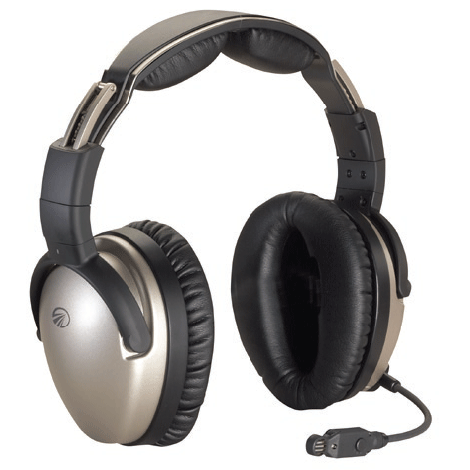
Equally frustrating is that I just got a new headset to wear in the cockpit, and I have not been able to try it out! I had to return my previous headset from Quiet Technologies; though I loved how light and comfortable it is, it turns out that that lightness also makes it susceptible to radio interference, and I was getting a horrendous squeal from the radio. So I got one of these:

My new set is a fancy Active Noise Reduction (ANR) headset, the Lightspeed Zulu. ANR uses electronics to actively cancel outside noise by using a "mirror image" soundwave to remove outside noise. The Zulu and the Bose Aviation Headset X are considered the two top ANR headsets currently -- I chose the Zulu because it is $150 less than the Bose, and has more audio features. For example, the Zulu has Bluetooth so you can connect wirelessly to a mobile phone, and also has a 1/8" audio-in jack for connecting to an MP3 player or other audio source in flight. The Bose has neither feature, and the audio for both headsets is rated comparably, so it was a no-brainer for me.

Why would you want to talk on a mobile phone in flight? Well, besides the obvious social calls, and telling folks when you are arriving at the airport, you can also use it to contact a Flight Service Station (FSS) to get weather updates while in the air. You can also do this using the radio, but it's good to have options! I think it will be a while if ever before I'd be comfortable enough to try to fly and chat on the phone, but I want a headset that will grow with me!

07 February 2009

The "S" Word


I've wrapped up my week of flight training; I have flown seven of the last eight days. I now have over 30 landings under my belt in the Zodiac, and they are no longer the mildly terrifying events they were the first few times. Now they are fun, and each one is a challenge to make the best approach and touchdown I can. I've gotten much better at them, and I can usually hold off on touchdown until I make it nice and gentle. The only issue I still have is that I occasionally still "plop" the nosewheel down after touchdown, but I'm getting better.

In the last couple of lessons we've also added radio communications with air traffic control (ATC) and other aircraft into the mix. Previously Eric had handled all the radio calls while I flew. I had spent a lot of time preparing for this, reading books and articles on proper communications requirements and etiquette. I was really nervous about talking on the radio, but after doing it for a couple of flights, I find to my surprise I actually enjoy the radio work. I'm not sure why, but it's kind of fun to talk to people when you're flying and let them know what you're up to.

So now Eric is using the "S" word: SOLO. That means making three circuits around the pattern, including three takeoffs and landings...by myself. This propect is both exciting and mildly terrifying. I'm pretty sure I can get the plane on the ground okay, but if I forget something or something goes wrong, there is nobody there to save my bacon. Once the wheels lift off, the plane will not get back on the ground safely unless I get it there.

The plan seems to be for me to solo during the next lesson where the weather permits and Eric sees me make at least three good landings with him first. Wish me luck!

03 February 2009

Lesson 6: Slips, Emergency Procedures, Crosswind Landings

This was a really packed lesson. We first did a few turns to get warmed up, then I learned how to slip. A slip is when you use a (usually strong) rudder deflection, coupled with opposite aileron. It is usually used to stay centered on the runway during a crosswind landing, or to lose altitude quickly by inducing a strong sink rate. There's nothing difficult about it, though I have not used one on landing (we usually use a different method, "crabbing" with the Zodiac, due to the Zodiac already having a pretty strong tendency to sink on approach).

We then did a simulated engine out descent to an off field landing. Not much different than a standard descent, pitch for best glide (65 knots), then look for a flat spot to set her down on. In an actual emergency you want to set the plane down as slowly as possible to avoid damaging people (primarily) or the plane (severely secondary).

The winds picked up after that, so we flew to Winder (KWDR) for some crosswind landings. It's hard enough for me to land at this point, but add a wind blowing directly across the runway and it gets really hairy. We did three of those at KWDR and then another one back at at Gwinnett (KLZU). That last one was really tough, and I almost had to abort and do a "go around" for another try, but salvaged it in the last few hundred feet.

Eric said I am really improving, so that's good enough for me!

02 February 2009

Lessons 4 & 5: I Landed an Airplane!

My last two lessons have included some review and basic flight maneuvers, but have been mainly concerned with...gulp...landings. I did not think I'd be trying to land the airplane so quickly, but so far I've managed to get it on the ground six times and have not bent or broken anything. A few of those landings could not exactly be termed "gentle," but as I said, nothing broken.

Maintaining airspeed, pitch, and sink rate (vertical speed) in the Zodiac is turning out to be a little on the difficult side. I don't think I'm pitching up enough when I add the full flaps, and that lets the speed build up quickly, which is no good. And if you get too slow the Zodiac starts to sink like a stone. It's a balancing act to keep everything just right, and I'm slowly learning how to best juggle everything. I'm getting more willing to make control movements without waiting for Eric to tell me, which is good, but I still miss a lot.

I'm also drifting off the centerline of the runway a lot, leading to some gross corrections. Eric mentioned that he wants me to make smaller corrections earlier, but honestly I think I'm having trouble keeping everything going at the same time. More practice is clearly the remedy here.

I'm scheduled for four hours of training tomorrow, so if I'm not a total basket case by the end of that, I should learn a lot and get in lots of practice, if the weather cooperates. I noticed today I'm getting more comfortable in the plane overall, and not being so ginger on the controls. The result seems to be more positive aircraft control and smoother maneuvers.

01 February 2009

Packing In the Time

Flight training is hard to do...you have work and other commitments during the week, and it's especially hard in the winter because the says are so short...there are no real flyable hours for a beginning student before or after working hours. Weekends are fine, but skills can degrade a lot during the week, and if the weekend weather does not cooperate you might not fly for two or three weeks.

My solution, implemented starting tomorrow, is to take time off work to train. I have taken the entire week off, and I am scheduled to fly twice per day! That's a lot of flying, and I'm hoping my skill level will improve markedly. I flew twice in the last two days and I can see a difference just between those two days, so that's good.

The forecast is for great weather all week, except some brief nastiness tomorrow (Monday), so keep your fingers crossed!

Lesson 3: Power Off Stalls

Okay, my lesson yesterday was on power off stalls. People without a lot of aviation knowledge hear "stall" and have visions of airplanes falling from the sky. It's really nothing like that, and is a very mild event. It occurs when the wing exceeds its critical angle of attack, the angle at which the wing loses lift and air stops flowing smoothly over it.

Stall recovery is generally pretty easy. You simply lower the angle of attack (typically by lowering the pitch of the airplane) and/or add power to increase airspeed. You also need to make sure the plane stays level and does not roll off onto one wing (which is the entry into a spin, which is generally not a good thing unless you are doing aerobatics or otherwise intentionally spinning the airplane).

In the Zodiac the spins are pretty much a non-event. As you lower the speed you have to pitch the nose up a bit to maintain altitude. With the flaps down the stall warning horn starts to make noise at about 50 knots, but the stall doesn't actually occur until about 38 knots. So there is plenty of time to know it's coming. The stall does not break sharply in the Zodiac; instead the plane just starts to mush, with the controls getting soft and movements needed to make changes get exaggerated. At the same time the vertical speed picks up, and even though you are level, you are sinking quite rapidly (500-1000 feet per minute).

Recovery is done by simply letting the nose come down (it wants to anyway) and adding power. The plane flies itself out of the stall almost instantly. The plane WANTS to fly. So that's it, power off stalls. Power on stalls will come later, and occur without reducing to power or lowering the flaps, instead using pitch to raise the angle of attack to the critical point.

27 January 2009

Sport Pilot vs. Private Pilot...What's the Difference?

I have mentioned on this blog that my flight training is designed to obtain a Sport Pilot Certificate (SPC), as opposed to a Private Pilot Certificate (PPC). So...what's the difference?

In order to become a pilot, traditionally the only way to do so (unless you want to fly an ultralight) was to obtain a PPC. The major requirements for the PPC are pretty straightforward:

1) Have a minimum of 40 hours of flight experience, including at least 20 hours of dual instruction and ten hours of solo flight, including three hours of night flying and a cross-country flight of at least 150 nautical miles.

2) Pass written, oral, and practical tests on flight skills and aeronautical knowledge in numerous fields including aircraft systems, flight theory, weather, and FAA regulations.

3) Ability to obtain an FAA Class III medical certificate (every five years for those under 40, every two for those 40+), which requires an exam and disclosure of any existing and some past medical conditions.

In 2005 the FAA codified the SPC, after a long lobbying effort by organizations like the Experimental Aircraft Association (EAA) and Aircraft Owners and Pilot Association (AOPA). The idea is to provide a way to get more pilots into the air in a less expensive and time-consuming manner, while maintaining the high standard of safety and proficiency the FAA expects of all pilots. To that end, the major differences in requirements between the SPC and PPC are:

1) Roughly half the flight experience requirements: a minimum of 20 hours of flight experience, including at least 15 hours of dual instruction and five hours of solo flight, and a cross-country flight of at least 75 nautical miles.

2) No medical certificate required. Instead, a sport pilot may "self certify" that he/she is medically fit to perform any flight, as long as he or she holds a valid state driver's license and has not failed an FAA medical (and not subsequently gotten a pass on the medical).

The idea with the medical requirement is that if you are healthy enough to legally drive a car, you can make the determination if you are healthy enough to fly. This is not a blank check; you are expected by the FAA to ground yourself if you have any medical condition that would impair your ability to safely conduct the flight in question. Failure to do so could, if you then caused an accident, result in suspension or revocation of your SPC, and other fines and sanctions as well.

And while the flight training requirements are roughly half of the PPC, in the real world that's not the case. The skills needed to fly any airplane are mostly the same, and the fact is those skills can't be rushed. My instructor told me he has yet to see a student that took any less time to solo for an SPC than for a PPC. So in reality I'd be surprised to see many students getting an SPC in less than 40-50 flight hours. The national average for PPC flight hours is about 60-70.

Okay, so what are the disadvantages of the SPC? Well, there are several limitations on where/when you can fly:

1) Flights must be conducted in clear VFR conditions (3 miles visibility, 1000ft ceilings).

2) Flights must be conducted during daylight hours (no night flights).

3) Flights must be conducted at 10,000 feet or below.

4) Cannot fly in tower-controlled airspace (class A, B, C) without additional training and a logbook endorsement.

5) Cannot fly in an aircraft with a faster level flight speed than 87 knots without additional training and a logbook endorsement.

6) Must only fly Light Sport Aircraft (LSA).

7) May carry no more than one passenger other than the pilot.

That looks like a long list, but in reality many of them are not limitations that are significantly painful. Most General Aviation (GA) pilots spend most of their time below 10,000 feet, and most spend very little time flying at night. And most can count on one hand the number of times they have filled more than two seats in their airplanes. Since logbook endorsements can remove some of the other restrictions, in reality there are few very onerous limitations. One tough one is the requirement to fly only LSAs.

What's an LSA? It's a plane that has a stall speed less than 45 knots, a top speed no more thna 120 knots (138mph), and weighs less than 1320 pounds. That is a tough requirement for a plane to make, but there are some really nice planes that do meet that definition. Look at the sexy planes pictured below:


So there you have it, the differences between a sport pilot and private pilot in a nutshell. And you got to see pictures of airplanes, too!
Followers