Waiting for N130AW to be repaired has been frustrating, and I have received word that it will not be back in service until the week of May 2. That means basically I will have not been in the air for nine weeks when I get to fly again.
I decided I didn't want all of that time to be wasted, so I started studying for the FAA knowledge test needed to get my pilot certificate. The test is a comprehensive test covering all aspects of flying including weather, procedures, regulations, aircraft systems, flight dynamics, and navigation among others. The test is a 40 question multiple choice test. That sounds easy, but the 40 questions are randomly selected from a bank of hundreds of questions. The only way to do well on the test is to all the material cold, since there's no way to know which questions you might be asked, or on what topics. The test is administered on a computer and 120 minutes are allowed to complete the test.
I brought the allowed items into the test: a flight calculator, a navigation plotter, and a pencil for working out any problems (scratch paper is provided and must be surrendered on leaving). You are given a booklet that has all the charts, tables, illustrations, and figures referenced in the test questions. You are only allowed to write on your scratch paper, not on the booklet.
I found the test to be pretty easy, but I think I lucked out in the random questions I was asked. They were mostly "simple" questions, not requiring any calculations. In fact, I only needed my flight calculator for one question. There were none of the "math intensive" questions I had studied, mostly navigation and weight/balance questions. Lucky in one sense, but a little disappointing I didn't get to put the skill I'd learned to use.
A score of 70% is passing. I scored 98%, meaning I missed one question. There were three questions on the test I had never seen before in my studying, and I'm pretty sure which one I missed. I really wanted to get 100%, but it's rare for anyone to get a perfect score, so I don't feel too badly. In fact, I'm very happy...I got a very good score and it's now behind me!
08 April 2009

10 March 2009
Just My Luck
I'm all ready to solo, butterflies in my stomach, excited and nervous. Then the flight school calls two hours before my flight. It turns out that Zodiac 130AW, the plane I was training in, had an accident on landing at the hands of a renter.
The plane was landed hard in a crosswind without proper crosswind correction. This caused the nose gear to fold about ninety degrees, which in turn caused the nose to lower enough for the propeller to strike the runway. This is a Bad Thing, because it destroyed the prop, and the prop is directly connected to the crankshaft of the Teledyne Continental Motors (TCM) 0-200 engine. That means the engine must be removed from the plane, torn down completely, and inspected for damage. It could be fine, or it could be time for a costly major overhaul of all the internals.
What does this mean for me? Sigh...it means I will not be flying the Zodiac for several weeks, at least. There are no other nearby flight schools offering Sport Pilot training. Peachtree-Dekalb airport (PDK) has it, but it's farther away (about an hour's drive or more) and it's is one of the most busy class delta airports in the nation. I don't think I want that kind of pressure during training.
I could take a couple of weeks and go to an accelerated sport pilot training course and finish up quickly, but that's at the whim of the weather, and I've already taken something like 50 hours off work for flight training already, so I'm not thrilled about burning up the rest of my leave.
For now I think I'll just wait and see what happens with N130AW. If it will only be down a few weeks, I can tough it out. If it will be 6, 8, 10+ weeks, I'll have to reevaluate what to do to get this thing finished. In the meantime I'm studying so I can get my written test out of the way.
Sigh...
The plane was landed hard in a crosswind without proper crosswind correction. This caused the nose gear to fold about ninety degrees, which in turn caused the nose to lower enough for the propeller to strike the runway. This is a Bad Thing, because it destroyed the prop, and the prop is directly connected to the crankshaft of the Teledyne Continental Motors (TCM) 0-200 engine. That means the engine must be removed from the plane, torn down completely, and inspected for damage. It could be fine, or it could be time for a costly major overhaul of all the internals.
What does this mean for me? Sigh...it means I will not be flying the Zodiac for several weeks, at least. There are no other nearby flight schools offering Sport Pilot training. Peachtree-Dekalb airport (PDK) has it, but it's farther away (about an hour's drive or more) and it's is one of the most busy class delta airports in the nation. I don't think I want that kind of pressure during training.
I could take a couple of weeks and go to an accelerated sport pilot training course and finish up quickly, but that's at the whim of the weather, and I've already taken something like 50 hours off work for flight training already, so I'm not thrilled about burning up the rest of my leave.
For now I think I'll just wait and see what happens with N130AW. If it will only be down a few weeks, I can tough it out. If it will be 6, 8, 10+ weeks, I'll have to reevaluate what to do to get this thing finished. In the meantime I'm studying so I can get my written test out of the way.
Sigh...
06 March 2009
Pre-Solo Passed & Emergency Procedures
I passed my pre-solo test today with flying colors, so Eric told me to expect to solo either Sunday or Monday...gulp! I think I'm ready, but there is a natural amount or apprehension and nerves that go with getting in an airplane and flying it around with no safety net in the form of an experienced in the right seat.
This morning we practiced engine out emergencies in the Zodiac. First a simulated off field landing from 3500 feet. This is not hard, you just pick a landing spot you can glide to and pitch the airplane for best glide speed (65 knots in the Zodiac). One thing Eric mentioned and I definitely found is that a field that looks great at 3500 feet might look questionable down low. The field I picked looked great up high, but once we got lower it looked a little small and had tall trees on the side I was approaching from. Clearly another case of something in aviation you need to be very conservative about.
We then went to WDR and did some simulated engine outs in the pattern and power off landings. This is an area where a Zodiac is not like a Cessna; once you pull the power to idle in the Zodiac it starts to come down like a meteor. At the 65 knot approach speed we were seeing sink rates up to 1200fpm. Our firt try at this in a normal pattern made it clear we could not make the runway from abeam the numbers. On the second try as soon as I cut the throttle abeam the runway numbers I started a moderate 180 degree turn. This time we made it very well. I gave the plane a little throttle just before the flair to soften the landing, but we would have made it easily even with no power. It just would have been a hard impact landing.
The Zodiac is a great plane, and a lot of fun. A Glider it aint.
This morning we practiced engine out emergencies in the Zodiac. First a simulated off field landing from 3500 feet. This is not hard, you just pick a landing spot you can glide to and pitch the airplane for best glide speed (65 knots in the Zodiac). One thing Eric mentioned and I definitely found is that a field that looks great at 3500 feet might look questionable down low. The field I picked looked great up high, but once we got lower it looked a little small and had tall trees on the side I was approaching from. Clearly another case of something in aviation you need to be very conservative about.
We then went to WDR and did some simulated engine outs in the pattern and power off landings. This is an area where a Zodiac is not like a Cessna; once you pull the power to idle in the Zodiac it starts to come down like a meteor. At the 65 knot approach speed we were seeing sink rates up to 1200fpm. Our firt try at this in a normal pattern made it clear we could not make the runway from abeam the numbers. On the second try as soon as I cut the throttle abeam the runway numbers I started a moderate 180 degree turn. This time we made it very well. I gave the plane a little throttle just before the flair to soften the landing, but we would have made it easily even with no power. It just would have been a hard impact landing.
The Zodiac is a great plane, and a lot of fun. A Glider it aint.
05 March 2009
Pre-Solo Test Tomorrow
Has it really been almost a month?!? Oh well. In that month, I had seven flight lessons scheduled. Five of seven were canceled due to weather. Highly annoying. I had a lesson two weeks ago, and it was bad; my head just was not in the game. I made five landings -- one of them was really good, two were just okay, and two severely sucked. Nothing dangerous, just pretty marginal technique on my part.
Then yesterday I had another lesson. That one went very well. No major mistakes, though I did miss one ATC radio call. Eric made the reply and didn't say anything, so I guess it's not a biggie. My landings were much better, but I am still having a some problems holding off the nosewheel enough on touchdown...I'll have to play with my stick technique after the main gear touches down and see if I can figure that out.
Tomorrow I have another lesson, and it's going to be some ground school and the FAA mandated pre-solo test. Once that and some logbook endorsements are out of the way, eric will be able to spring my first solo on me whenever he chooses. That's pretty scary, but one learns by doing, right? Wish me luck!
Then yesterday I had another lesson. That one went very well. No major mistakes, though I did miss one ATC radio call. Eric made the reply and didn't say anything, so I guess it's not a biggie. My landings were much better, but I am still having a some problems holding off the nosewheel enough on touchdown...I'll have to play with my stick technique after the main gear touches down and see if I can figure that out.
Tomorrow I have another lesson, and it's going to be some ground school and the FAA mandated pre-solo test. Once that and some logbook endorsements are out of the way, eric will be able to spring my first solo on me whenever he chooses. That's pretty scary, but one learns by doing, right? Wish me luck!
16 February 2009
Another Scrubbed Flight and a New Headset
Argh, I was unable to fly Saturday as planned, due to weather. 700ft ceilings and rain are not conducive to student VFR flight. Ah well...I am on the schedule to fly both next Saturday and Sunday, so hopefully two flights close together will make up for the fact I will not have been able to fly in two weeks. It's frustrating to get close to solo and then have to wait so long, hoping my skills don't atrophy to uselessness and end up requiring more hours to get back up to speed.
Equally frustrating is that I just got a new headset to wear in the cockpit, and I have not been able to try it out! I had to return my previous headset from Quiet Technologies; though I loved how light and comfortable it is, it turns out that that lightness also makes it susceptible to radio interference, and I was getting a horrendous squeal from the radio. So I got one of these:
My new set is a fancy Active Noise Reduction (ANR) headset, the Lightspeed Zulu. ANR uses electronics to actively cancel outside noise by using a "mirror image" soundwave to remove outside noise. The Zulu and the Bose Aviation Headset X are considered the two top ANR headsets currently -- I chose the Zulu because it is $150 less than the Bose, and has more audio features. For example, the Zulu has Bluetooth so you can connect wirelessly to a mobile phone, and also has a 1/8" audio-in jack for connecting to an MP3 player or other audio source in flight. The Bose has neither feature, and the audio for both headsets is rated comparably, so it was a no-brainer for me.
Why would you want to talk on a mobile phone in flight? Well, besides the obvious social calls, and telling folks when you are arriving at the airport, you can also use it to contact a Flight Service Station (FSS) to get weather updates while in the air. You can also do this using the radio, but it's good to have options! I think it will be a while if ever before I'd be comfortable enough to try to fly and chat on the phone, but I want a headset that will grow with me!
Equally frustrating is that I just got a new headset to wear in the cockpit, and I have not been able to try it out! I had to return my previous headset from Quiet Technologies; though I loved how light and comfortable it is, it turns out that that lightness also makes it susceptible to radio interference, and I was getting a horrendous squeal from the radio. So I got one of these:
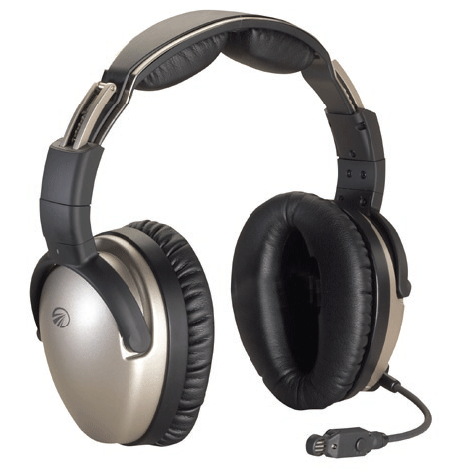
My new set is a fancy Active Noise Reduction (ANR) headset, the Lightspeed Zulu. ANR uses electronics to actively cancel outside noise by using a "mirror image" soundwave to remove outside noise. The Zulu and the Bose Aviation Headset X are considered the two top ANR headsets currently -- I chose the Zulu because it is $150 less than the Bose, and has more audio features. For example, the Zulu has Bluetooth so you can connect wirelessly to a mobile phone, and also has a 1/8" audio-in jack for connecting to an MP3 player or other audio source in flight. The Bose has neither feature, and the audio for both headsets is rated comparably, so it was a no-brainer for me.
Why would you want to talk on a mobile phone in flight? Well, besides the obvious social calls, and telling folks when you are arriving at the airport, you can also use it to contact a Flight Service Station (FSS) to get weather updates while in the air. You can also do this using the radio, but it's good to have options! I think it will be a while if ever before I'd be comfortable enough to try to fly and chat on the phone, but I want a headset that will grow with me!
07 February 2009
The "S" Word

I've wrapped up my week of flight training; I have flown seven of the last eight days. I now have over 30 landings under my belt in the Zodiac, and they are no longer the mildly terrifying events they were the first few times. Now they are fun, and each one is a challenge to make the best approach and touchdown I can. I've gotten much better at them, and I can usually hold off on touchdown until I make it nice and gentle. The only issue I still have is that I occasionally still "plop" the nosewheel down after touchdown, but I'm getting better.
In the last couple of lessons we've also added radio communications with air traffic control (ATC) and other aircraft into the mix. Previously Eric had handled all the radio calls while I flew. I had spent a lot of time preparing for this, reading books and articles on proper communications requirements and etiquette. I was really nervous about talking on the radio, but after doing it for a couple of flights, I find to my surprise I actually enjoy the radio work. I'm not sure why, but it's kind of fun to talk to people when you're flying and let them know what you're up to.
So now Eric is using the "S" word: SOLO. That means making three circuits around the pattern, including three takeoffs and landings...by myself. This propect is both exciting and mildly terrifying. I'm pretty sure I can get the plane on the ground okay, but if I forget something or something goes wrong, there is nobody there to save my bacon. Once the wheels lift off, the plane will not get back on the ground safely unless I get it there.
The plan seems to be for me to solo during the next lesson where the weather permits and Eric sees me make at least three good landings with him first. Wish me luck!
03 February 2009
Lesson 6: Slips, Emergency Procedures, Crosswind Landings
This was a really packed lesson. We first did a few turns to get warmed up, then I learned how to slip. A slip is when you use a (usually strong) rudder deflection, coupled with opposite aileron. It is usually used to stay centered on the runway during a crosswind landing, or to lose altitude quickly by inducing a strong sink rate. There's nothing difficult about it, though I have not used one on landing (we usually use a different method, "crabbing" with the Zodiac, due to the Zodiac already having a pretty strong tendency to sink on approach).
We then did a simulated engine out descent to an off field landing. Not much different than a standard descent, pitch for best glide (65 knots), then look for a flat spot to set her down on. In an actual emergency you want to set the plane down as slowly as possible to avoid damaging people (primarily) or the plane (severely secondary).
The winds picked up after that, so we flew to Winder (KWDR) for some crosswind landings. It's hard enough for me to land at this point, but add a wind blowing directly across the runway and it gets really hairy. We did three of those at KWDR and then another one back at at Gwinnett (KLZU). That last one was really tough, and I almost had to abort and do a "go around" for another try, but salvaged it in the last few hundred feet.
Eric said I am really improving, so that's good enough for me!
We then did a simulated engine out descent to an off field landing. Not much different than a standard descent, pitch for best glide (65 knots), then look for a flat spot to set her down on. In an actual emergency you want to set the plane down as slowly as possible to avoid damaging people (primarily) or the plane (severely secondary).
The winds picked up after that, so we flew to Winder (KWDR) for some crosswind landings. It's hard enough for me to land at this point, but add a wind blowing directly across the runway and it gets really hairy. We did three of those at KWDR and then another one back at at Gwinnett (KLZU). That last one was really tough, and I almost had to abort and do a "go around" for another try, but salvaged it in the last few hundred feet.
Eric said I am really improving, so that's good enough for me!
Subscribe to:
Posts (Atom)